Chimney Flashing, Repair & Caps
Greg's Construction Co repairs chimney flashing, installs chimney caps, fixes crowns and repoints mortar for homes in North Reading and across the North Shore. The flashing where the chimney meets the roof is where most chimney leaks start, and it's where we look first. Estimates are free.
Get a Free Chimney Estimate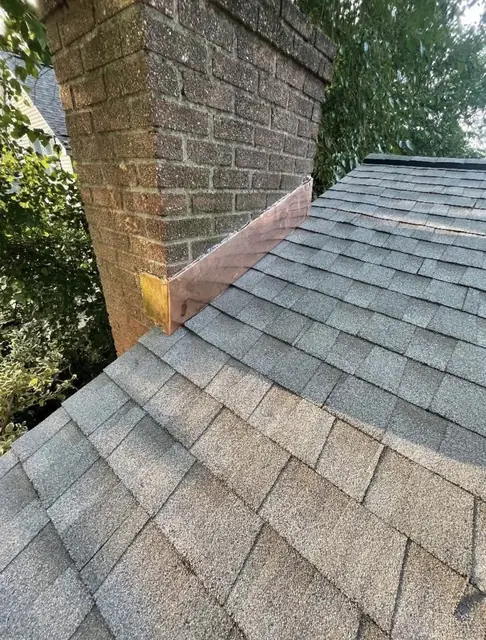
Why does my chimney leak where it meets the roof?
A chimney is a big masonry box sticking up through the roof. The roof and the chimney move differently as the seasons change, so the joint between them has to be sealed with metal, not caulk. When that metal fails, water runs down the outside of the brick, gets behind the flashing, and shows up on a ceiling, a wall or in the attic. It's one of the most common roof leaks we're called about.
Proper chimney flashing is two layers working together. Step flashing is a series of short L-shaped pieces woven in with each course of shingles up the sides of the chimney. Counter flashing is set into the mortar joints of the brick and folds down over the step flashing, so water running down the brick is sent out onto the roof. The downhill side gets an apron, and on wider chimneys the uphill side needs a cricket to split water around it.
The flashing in this photo is copper, set along the side of the chimney where it meets the shingles.
- Chimney flashing repair and replacement
- Step and counter flashing set into the mortar joints
- Leak diagnosis for interior staining or water in the firebox
- Flashing tied into asphalt or metal roofing
What are the signs of chimney water damage?
Chimney leaks are easy to miss because the water often travels before it shows. Check for these, inside and out:
- Brown staining or bubbling paint on the ceiling or wall next to the chimney
- Water or damp ash in the firebox after rain
- Damp or darkened wood on the rafters and sheathing around the chimney in the attic
- White, chalky deposits on the brick, which means water is moving through the masonry
- Crumbling or missing mortar between bricks
- Cracks in the crown on top of the chimney
- Flashing that's bent, pulled away from the brick, or held on with tar and caulk
- No cap on the flue, or a rusted one
If you see staining, don't wait for it to spread. A chimney leak that sits for a winter can rot the roof deck around it, and freeze-thaw cycles open up cracks in the masonry. You can read more about telling a small repair from a bigger problem in our guide to the signs you need a roof repair, or see our roof repair service and the leak and storm damage repair overview.
What's the difference between a chimney cap and a crown?
The crown is the masonry slab on top of the chimney that covers the brick around the flue. It should slope away from the flue so water runs off. Crowns crack over time, and every crack lets water straight down into the chimney. Small cracks can be repaired and sealed. A crown that's badly broken needs to be rebuilt.
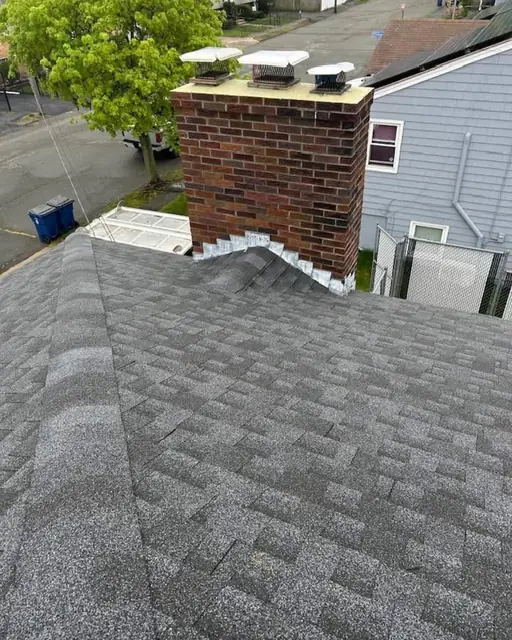
The cap sits on top of the flue itself. It keeps rain and snow out, and its mesh sides keep out birds, squirrels and leaves. The chimney in this photo has a separate cap on each of its three flues. A cap is one of the least expensive ways to keep water out of a chimney, and it's often the first thing we recommend on a chimney that doesn't have one.
- Chimney cap installation and replacement
- Crown repair and waterproof sealing
- Mesh screening against animals and debris
Does your chimney need repointing?
Mortar wears out faster than brick. After enough winters, the joints erode, crack or fall out, and the chimney starts soaking up water like a sponge. Repointing, also called tuckpointing, means grinding out the failed mortar to a sound depth and packing in new mortar. It restores the chimney's ability to shed water and keeps loose bricks from working free.
We also handle masonry patching on brick and stone chimneys, along with the other exterior masonry repairs we do across the North Shore. If a chimney has been leaking for a long time, repointing and new flashing usually go together. New flashing needs sound mortar joints to hold the counter flashing, and fresh mortar won't stay dry if the flashing below it keeps failing.
- Mortar repointing and tuckpointing
- Masonry patching
- Brick and stone chimney restoration
Should chimney work be done during a new roof?
Yes, and it's the best time for it. The step flashing is woven into the shingles, so it can't be fully replaced without taking the surrounding roofing off. During a roof replacement that roofing is coming off anyway. Reusing old chimney flashing on a new roof is one of the most common reasons a new roof leaks.
When we reroof, we plan the chimney as part of the job. That means new step and counter flashing, a look at the crown and cap while we're already up there, and repointing if the joints need it before new counter flashing goes in. The same applies to skylights, which have the same kind of flashing joint. Whether the new roof is asphalt shingles or metal roofing, the chimney details are covered in the estimate, not added as a surprise later. If ice builds up behind your chimney in winter, see our guide to preventing ice dams, and make sure your gutters aren't sending water back toward the roof.
"I'm a contractor that's used Greg on several projects. His work is always top notch and he is very knowledgeable with all phases of roofing."
Rich Ohare, Google ReviewChimney questions we get asked
Can chimney flashing be repaired, or does it need replacing?
Minor issues, like a counter flashing that has pulled out of its mortar joint, can sometimes be reset and sealed. Flashing that's rusted through, was installed without step flashing, or is held on with tar needs to be replaced. We'll tell you which one you have.
Is roofing tar or caulk a good fix for a chimney leak?
Only as a short-term patch. Tar and caulk dry out and crack with the freeze-thaw cycle, and then the leak comes back. Lasting repairs use metal flashing lapped the right way.
Do I need a chimney cap if I don't use my fireplace?
Yes. An open flue lets rain and snow into the chimney whether you burn wood or not, and an unused chimney is an easy place for animals to nest.
How much does chimney repair cost?
It depends on what's failing. A cap is a small job. Replacing flashing or rebuilding a crown is more involved, and repointing depends on how much of the chimney needs it. We give free written estimates after looking at the chimney up close.
Why is there water in my fireplace after it rains?
Water in the firebox usually comes from the top of the chimney: a missing or damaged cap, or a cracked crown. It can also soak through worn mortar joints. Flashing leaks tend to show up on the ceiling or in the attic instead. Knowing where the water appears helps narrow down the fix.
What towns do you serve?
We're based in North Reading and work across the North Shore, including Reading, Wilmington, Lynnfield, Wakefield, Andover, North Andover, Stoneham, Salem and Peabody. Call (978) 423-3581 or request an estimate. See all our services or finished work in the gallery.
Roofing guides
Straight answers on leaks, repairs and roof replacement.
How It Works
Getting started with Greg's is easy. Here's what to expect.
Call or Request Online
Call Greg at (978) 423-3581 or fill out our contact form. We'll schedule a visit — usually within a day or two.
Free On-Site Estimate
Greg personally inspects and gives you a detailed written estimate. No pressure, no upselling.
Professional Installation
Our experienced crew handles the full job. We protect your property and keep you updated throughout.
Final Walkthrough
Greg walks the completed job with you. No open punch list — your satisfaction is the final sign-off.
Got a leak around the chimney?
Free estimates — call or request online. Licensed & insured in MA.